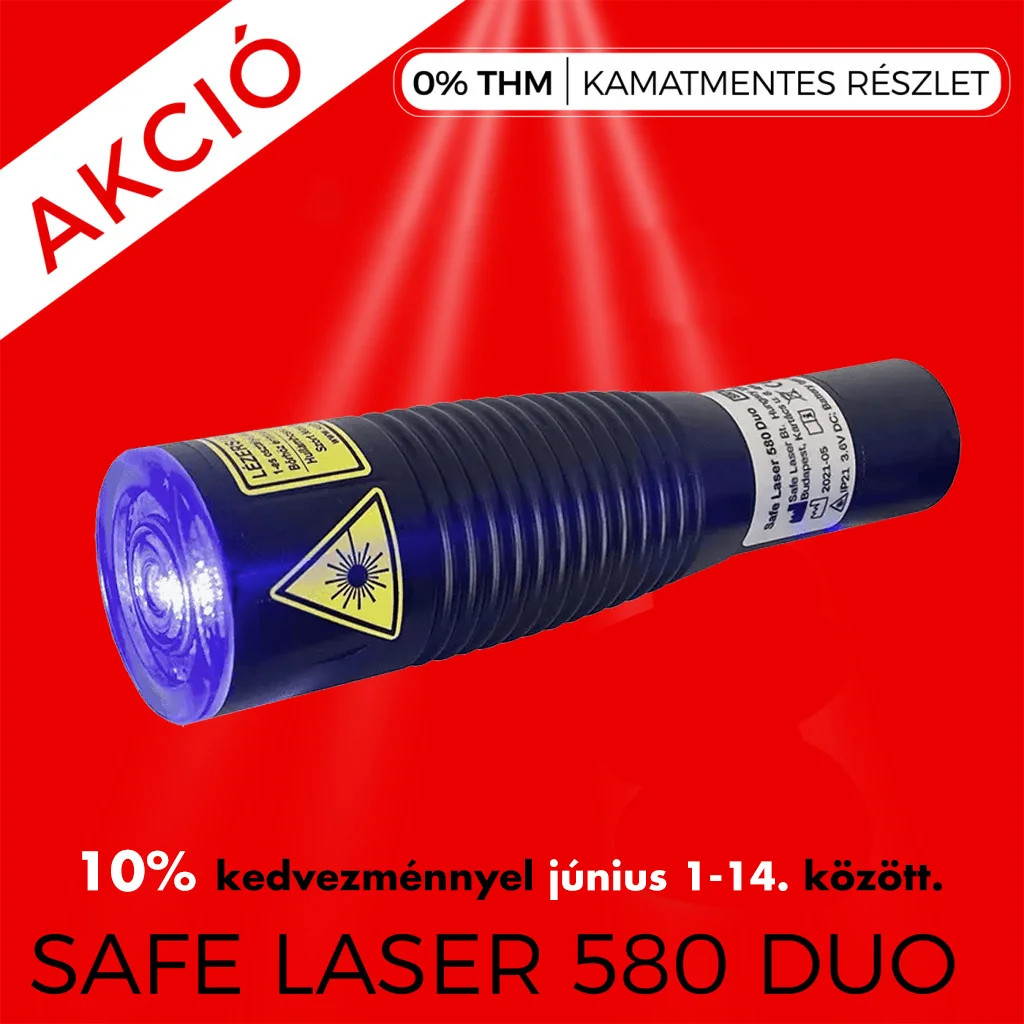
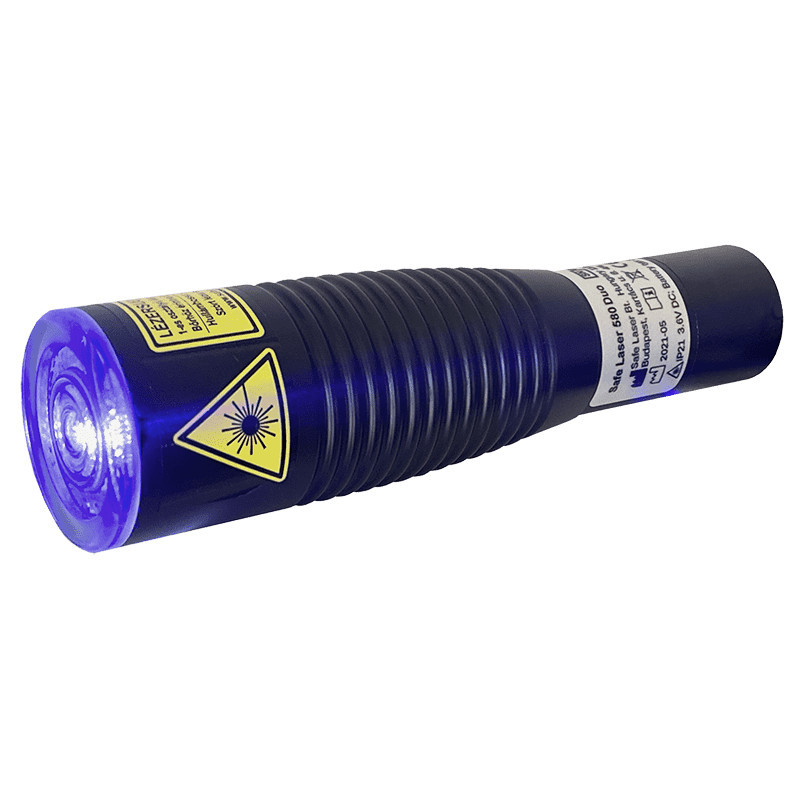
SAFE LASER 580 DUO – Laser Light Therapy Device for Veterinary Use
The Safe Laser® 580 Duo device emits two types of laser light:
Blue (450 nm) laser – 80 mW
Infrared (808 nm) laser – 500 mW
The light of infrared (808 nm) lasers is barely visible to the naked eye; when the device is switched on, the blue laser light is predominantly visible.
Which wavelength is recommended for which conditions?
The blue (450 nm) laser light is most effective up to approximately 0.5 cm below the skin surface, therefore it plays an important role in the treatment of superficial lesions.
In addition, when applied into the nostril, the light passes through the thin nasal mucosa and, via the dense vascular network, reaches hemoglobin, which plays a key role in oxygen and nutrient delivery. In dogs and cats, a similar effect can be achieved by illuminating the skin over the jugular groove.
Infrared (808 nm) laser light is absorbed in deeper tissue layers (its biological effects may be present even at 8–10 cm depth), making it an excellent choice for the therapy of musculoskeletal conditions, where its pain-relieving and anti-inflammatory effects are especially important and it supports the healing of muscles, tendons, and joints.
At higher doses, it may also support the regeneration of joint cartilage surfaces and cartilage tissue.
Experience shows that infrared laser therapy is more effective for pain relief.
With the appropriate accessory, the SL580 Duo device is also suitable for treating conditions by illuminating the nasal mucosa (e.g., respiratory inflammations).
SafeLaserlogo
Technical specifications
Output power: 580 mW continuous (diffused emission)
Class 1 laser product
Wavelength: 808 nm (infrared) + 450 nm (blue)
Rechargeable battery operation
Package contents: SL 580 device, battery, charger, nasal applicator, rubber ring, red carrying case
Which conditions is it recommended for?
+ Dermatological conditions
• Skin abrasions, superficial injuries
• Post-operative wounds: supports normal tissue regeneration
• Supports the healing of slow-healing wounds and ulcers
• Supports the healing of herpes.
+ Dental and oral conditions
Diseases of the skin and superficial mucosa (e.g., herpes, oral sores, ulcers, aphthae) and gum recession can be treated effectively with the optional fiber optic probe.
• Reduces post-operative dental pain and inflammation and supports soft tissue and bone healing.
• Supports the healing of periodontitis and periodontal disease.
• Supports the healing of gingivitis.
• Accelerates healing of gum and oral mucosal injuries (e.g., mucositis, aphthae).
+ Ear, nose and throat conditions
Always illuminate the ear only with a fiber optic probe!
For treating the nostrils, use the nasal applicator. Never use a fiber optic probe inside the nostril!
In many cases, it reduces or eliminates tinnitus (ringing in the ears).
In acute hearing loss, use with a fiber optic probe may improve hearing. The main cause of acute hearing loss is insufficient local blood circulation, which may develop due to bacterial or viral inflammation, or due to systemic circulatory problems. By reducing local inflammation, laser therapy may support improved hearing.
It may relieve symptoms of sinusitis and respiratory inflammations.
+ Musculoskeletal conditions
For deeper tissue treatment, 808 nm infrared lasers (SL500 and SL1800) are recommended.
Milder musculoskeletal injuries:
• Sprain (distorsio), muscle/ligament/tendon rupture (ruptura), bone fracture (fractura)
Overuse-related conditions:
• Tendon sheath inflammations (tendinitis), muscle inflammations (myositis)
• Periostitis at muscle attachment or origin (e.g., “tennis elbow” – periostitis at the attachment of the forearm extensor muscles caused by overuse)
Degenerative changes:
• Joint inflammation (arthritis)
• Pain relief and inflammation reduction in spine disorders (e.g., lumbago)
• Muscle disorders: e.g., muscle pain, restricted joint mobility (contracture)
• Rheumatic pain (rheumatoid arthritis)
Musculoskeletal conditions can cause problems and pain in different parts of the body and/or in multiple joints.
In musculoskeletal pain, the pain is often not felt at the source of the problem, but radiates to another area, such as a joint. For effective pain relief, it is recommended to treat not only the painful area, but also to identify and treat “radiating pain points – trigger points.”
Soft-laser therapy can shorten the healing time of traumatic injuries!
After surgery, use the laser 1–2 times daily to support faster recovery.
Treatment protocol
+ Method of application
Place the Safe Laser 500 Infra laser in contact with the painful or injured area and illuminate for the specified time, then move to the next point. (A disposable protective cover for the treatment head can be ordered.) Multiple points can be treated in sequence depending on the size of the painful or injured area. Typically, “pressure-sensitive” points should be treated.
For maximum safety, switch on the laser only when it is placed on the skin surface to avoid accidental eye exposure to laser light. At the end of the treatment, switch the device off before lifting it from the skin surface.
To reach tissue layers deeper than 8 cm, you can improve penetration by gently pressing the Safe Laser 500 Infra treatment head slightly into the tissues. If, for example, the laser cannot be placed directly on the skin due to an open wound, hold it as close as possible (max. 0.5 cm). In this case, extend the treatment time by 1 minute per point to ensure sufficient energy reaches the body to support healing.
Safe_Laser_banner2_laserterapia.hu
+ Treatment frequency
The frequency of treatments depends on how long the condition has been present (How long ago did the problem occur?).
1. Acute conditions (recent onset) and post-operative cases: Apply treatment daily for 1–2 weeks, then 3 times per week until symptoms resolve. Improvement can often be noticed during the first session or within 1 day. (In acute cases, during the first session, treatment may be continued as long as improvement is observed.)
2. Chronic (prolonged) conditions (present for more than 6–8 weeks): Long-standing conditions should be treated less frequently. Use the laser 3 times per week until symptoms resolve or significantly decrease.
In chronic (long-standing) conditions, healing naturally takes longer (days, weeks, sometimes months). After the first treatments, mild tingling may be felt, or in painful conditions the pain may temporarily increase (treatment reaction). This is transient. Pain intensity gradually decreases as the number of treatments increases and typically resolves after 3–4 sessions, followed by improvement. The treatment reaction is a normal accompanying phenomenon and indicates that the patient is responding to therapy. If pain increases after treatment, reduce treatment time and frequency by half. After 3–4 sessions, you may return to the original treatment approach.
If you notice that a painful joint neither improves nor “worsens,” you likely treated with too low a dose (irradiation time too short). In this case, you may increase treatment time by approximately 2–3 minutes.
If, with regular treatments, the pain increases or becomes more prolonged, this may indicate that the dose was too high. Over-treatment does not cause permanent damage. In such cases, skip a few treatments and continue therapy with a lower dose (fewer sessions and/or shorter treatment time).
One reason for accompanying pain is the sudden start of microcirculation (blood flow in the smallest vessels) in congested areas. Accumulated breakdown products in stagnant regions (which had not been carried away) may suddenly enter circulation, therefore, rarely, nausea, fatigue, and malaise may occur (after treating large areas with a high dose).
If pain does not decrease within a few weeks even with an increased dose, the pain likely only radiates to this area and the underlying cause is elsewhere.
More frequent or longer treatments do not necessarily speed up healing, because there is a biological threshold beyond which irradiation can no longer further stimulate the cells.
+ Treatment duration
Different conditions require different amounts of energy (Joules) for effective healing. Higher energy delivery can be achieved by longer irradiation.
4–10 Joules = 2–2.5 minutes of irradiation: strains, bruises, muscle spasms, improving microcirculation, milder musculoskeletal injuries, acute and chronic inflammations, dental and oral conditions, skin problems.
15 Joules = 3 minutes of irradiation: pain relief, more severe musculoskeletal conditions.
25 Joules = 5 minutes of irradiation: cartilage regeneration, treatment of deeper musculoskeletal injuries, ligament/muscle/tendon fiber tears, bone fractures (initially up to 2 times daily).
With fiber optic probe: 4–8 Joules = 15–30 seconds of irradiation.
+ Determining treatment points
For muscles: palpate the muscles thoroughly and treat the “pressure-sensitive” points.
For joints: treatment is typically performed along the joint line. By flexing the limb, the joint can be “opened,” allowing light to reach deeper into the joint. Palpate the muscles that move the joint and treat their sensitive points as well.
For tendons: treat at the tendon attachment, at the muscle–tendon junction, and/or at “pressure-sensitive” points. Even if you do not find the exact treatment points, therapy may still be effective, as Safe Laser Infra light is diffused over a large surface.